Rechercher dans ce blog

Thursday, April 1, 2021

Samsung Design Leader Federico Casalegno's Take on Seizing the Humanity-Centered Design Opportunity - Samsung US Newsroom - Samsung Newsroom US

brande.indah.link

In early March of last year, Federico Casalegno, Samsung’s Head of the Samsung Design Innovation Center (SDIC) and Mobile Experience Planning, was leading a team of designers spread across three countries. Most of his team worked out of the SDIC design lab in the heart of Silicon Valley—a place of hands-on prototyping and research where many of the company’s most future-looking technologies begin to take shape. Then the COVID-19 pandemic hit, and seemingly overnight everything changed. Casalegno and many of his fellow designers began working from home, where they conducted team meetings, user research interviews, and product demos through video conversations.

Federico Casalegno, Samsung’s Head of the Samsung Design Innovation Center (SDIC) and Mobile Experience Planning

The rapid transformation of the team’s work life was a crash course in extreme user empathy. They, like the very people they were designing products for, had to adjust to a new reality where every interaction was mediated through a screen. As school courses, business meetings, fitness classes, and healthcare visits moved online, Casalegno had a lightbulb moment: Despite the physical distance between people, humanity is more connected than ever; and designers have a unique opportunity to create a more equitable, healthy, and sustainable shared future for people across the planet.

Even before COVID, Samsung’s design ethos was humanity-centered and experience-driven. This is made possible by placing people and their diverse set of needs at the very core of all aspects of the design journey, which is preceded by gaining an understanding of societies, cultures, and human values. Values more than technological capabilities dictate what the designers create.

The pandemic reaffirmed Casalegno and his team’s commitment to designing products and experiences that begin with a real user need. For instance, during research conversations, people said they craved intuitive ways to connect with their family, friends, and colleagues. They wanted technology that centered around them and their evolving needs. Most of all, they needed their technology to simply work—reliably and effortlessly. “In a moment of crisis people turn their attention to the essentials,” Casalegno said.

Designing products that feel essential requires insights into human behavior. The best technology begins with understanding the motivations behind why humans need technology in the first place. Casalegno believes that most people don’t adopt products based on specs alone. They don’t want a camera—they want a tool to capture and share a moment. They don’t want headphones—they want a way to intimately connect with music and interact with people. “People don’t just buy products. They buy what our products enable,” said Casalegno.

With that in mind, last spring Samsung began to reimagine its approach to video conferencing. People had long used video calls for routine conversations, but their needs quickly became more complex as they lived more of their lives online. The design team started with a deep dive research project into how people used video calling and what they believed was lacking in the experience. “Samsung saw how the entire interface for video could be substantially improved,” Casalegno said. Engaging in more socially complex situations, from a guitar lesson and a birthday party with a dozen friends to a collaborative meeting with colleagues and a telehealth doctor’s visit, became the norm. Samsung realized there was an opportunity to create a new, highly intuitive video conferencing standard that reflects the nuances of human interaction. “We wanted to shift from video conferencing tools designed for limited use towards powering true video conversations that enable communication, socialization, and learning,” said Casalegno.

The newfound flexibility of Samsung’s video conferencing experience centers around a few key features. Instead of tethering a video call to a single device, the designers created a Multi-View capability that allows people to interact with multiple screens simultaneously. Tapping a Samsung Galaxy smartphone, specifically the Galaxy S20 line and the Galaxy Z Flip, to the new QLED TV allows people to watch TV while on a video call. Meanwhile, beginning in May 2021, using the Google Duo app will enable the TV to display up to five people on screen at the same time. And to account for ergonomics, people can attach a USB camera to the TV to activate an auto-focus feature that keeps them in the frame as they move around the room. These initial features, unveiled at First Look 2021, are a step towards Samsung’s vision of a world where anticipatory technology will make lives easier and more enjoyable. “Technology needs to be seamlessly integrated into our lives,” he said. “It should anticipate what we need before we need it.”

Casalegno had already been exploring the idea of building a more frictionless future in the years leading up to the pandemic. In fact, in 2018, he and the UX team embarked on a project to explore how people experience storytelling through photography. Storytelling is at the heart of what Samsung’s technology is designed to encourage. It’s how people understand the world around them; it’s a mechanism for connecting to others and creating shared memories. It was important that the new experience enabled people to spend less time learning how to use a phone camera’s features and more time effortlessly capturing a moment.

The result is the Samsung Galaxy S21, S21+, and S21 Ultra’s latest enhanced Single Take feature, which allows people to shoot multiple modes of image with a single tap of the shutter button. The camera is able to capture video, stills, and automatically apply various effects like a wide-angle shot and a bokeh/blur effect – all while the built-in artificial intelligence identifies the best shots to highlight. Other features on the new camera include Zoom Lock, which locks in on a subject to ensure it stays in focus and sharp while under telephoto zoom, and Director’s View, which allows people to capture videos with both front and rear cameras at the same time. These new features are a means to an end—as the future marches onward, the devices we use to capture memories will inevitably change, but the motivation behind documenting them will remain.

Single Take Feature

Applying those deep insights on human behavior to physical products has happened much faster since the pandemic began. “Moments of crisis have a way of spurring innovation faster than it might otherwise happen. And COVID fast-forwarded the future,” he said. For Casalegno’s team, the pandemic pressed reset on not just what they create, but how they create. It’s been a reminder for designers that the only way to build the future people desire is to put humanity at the center of everything they make. And the only way to predict the future is to design the future we think is good for our societies and for our planet. “Our role as leaders is to make sure that our designers evolve in an environment driven by values and fulfilled with equality and justice, and great hope for all,” he said. “Then they are empowered to design with purpose and with the values they think can truly help humanity.”

The Link Lonk


April 01, 2021 at 09:38PM
https://ift.tt/3fuAtgV

Samsung Design Leader Federico Casalegno's Take on Seizing the Humanity-Centered Design Opportunity - Samsung US Newsroom - Samsung Newsroom US

https://ift.tt/2O3clnm
Samsung

Samsung Develops New 5G Radio Technology for Efficient 5G Deployments in Mid-Band Spectrum - Samsung US Newsroom - Samsung Newsroom US

brande.indah.link

New Samsung technology doubles bandwidth support of its mid-band portfolio, helping operators minimize hardware needs and simplify 5G rollouts

Samsung Electronics. Co., Ltd. has developed a new 5G wideband radio technology that expands bandwidth support for its next-generation radios, including Massive MIMO radios, to help operators drive more flexible and cost-effective 5G deployments. With this new technology, Samsung will extend the bandwidth support of its 5G radios to 400MHz—double the 200MHz supported by its current commercial radios.

With wider bandwidth support, Samsung’s radios will help operators maximize the utility of their mid-band spectrum for 5G networks, while using less hardware. The new technology will help operators minimize the number of radios required when managing spectrum in various deployment scenarios. This includes when an operator owns non-contiguous frequencies within 400MHz of bandwidth. Operators can also use this solution for RAN sharing, where they actively share network infrastructures with other operators through joint deployments.

Related News

Mid-Band Boost

Mid-band frequencies deliver a combination of wide coverage, high speeds and low latency. Samsung’s new radios will help accelerate operators’ 5G rollouts in mid-band spectrum.

“We are proud to develop new solutions that can help operators drive deployment efficiency by minimizing hardware changes and reducing installation costs—even as they expand their spectrum range,” said Dong Geun Lee, Vice President and Head of H/W R&D Group, Networks Business at Samsung Electronics. “Through our technical expertise and industry-leading 5G capabilities, we’re excited to continue delivering innovative 5G solutions that will bring more benefits to operators and their customers.”

Samsung’s new wideband solutions, including Massive MIMO radios, will be commercially available in early 2022, offering more operational and deployment advantages to operators.

The new 5G radio technology is another innovation for mid-band 5G spectrum support, following Samsung’s recent announcement of the Mobility Enhancer. Mobility Enhancer is Samsung’s new AI-based technology that improves beamforming performance in its Massive MIMO radios, potentially increasing the throughput by up to 30 percent in mobility environments.

Samsung has pioneered the successful delivery of 5G end-to-end solutions including chipsets, radios, and core. Through ongoing research and development, Samsung drives the industry to advance 5G networks with its market-leading product portfolio from fully virtualized RAN and Core to private network solutions and AI-powered automation tools. The company is currently providing connectivity to hundreds of millions of users around the world.

The Link Lonk


April 01, 2021 at 08:15PM
https://ift.tt/3fFaHq2

Samsung Develops New 5G Radio Technology for Efficient 5G Deployments in Mid-Band Spectrum - Samsung US Newsroom - Samsung Newsroom US

https://ift.tt/2O3clnm
Samsung

Stratix Finding 'Huge Growth' With Samsung Devices Amid B2B Push - CRN

brande.indah.link

Mobility solution provider Stratix has seen strong and growing demand for Samsung products as the device maker has expanded its push to win new business customers with the help of channel partners, a Stratix executive said.

Samsung’s expanded emphasis on B2B in recent years is clearly “resonating” with customers in the market, said Gina Daniel-Lee, vice president of strategic alliances and partnerships at Peachtree Corners, Ga.-based Stratix, in an interview with CRN.

[Related: Review: 5 Top Features On Samsung’s Galaxy Tab Active3]

“We’ve seen an increased interest in the Samsung products—not just with our existing customers, but it’s also helped to be a point of entry with new logo customers as well,” Daniel-Lee said.

Key reasons behind the growing demand include Samsung’s “very compelling products”—such as the Galaxy Tab Active2 tablet, which offers a mix of ruggedness with a consumer look and feel—as well as the company’s investments in working with partners and taking a more verticalized approach in the market, she said.

“Samsung has done a good job at trying to listen to the enterprise and make adjustments where they can to address the needs of the ever-changing enterprise landscape,” Daniel-Lee said.

In January, Samsung launched its successor to the popular Tab Active2 in the U.S., the Galaxy Tab Active3, with a number of updates including enhanced services for IT administrators.

Other rugged mobile devices for business in the Samsung portfolio include the Galaxy Tab Active Pro tablet and the Galaxy XCover Pro smartphone. Meanwhile, Samsung has also outfitted its mainstream smartphones and tablets—such as the Galaxy S21 and Galaxy Note 20 smartphones—with a growing number of business-friendly features in recent years.

Stratix—which also partners with other mobile device makers including Apple, Google and Panasonic—is “uniquely positioned” within the Samsung channel as a leading partner of the company, Daniel-Lee said.

For Stratix, crucial moves during the market upheaval of 2020 included expanding from offering mainly Samsung smartphones and tablets into providing customers with Samsung Chromebooks and laptops as well, she said.

“That has significantly impacted the pipeline that we’ve built together in 2021 in a really positive way and has positioned us for huge growth in this new year,” Daniel-Lee said.

Recent years have seen Samsung invest heavily into helping partners to align with its vertical strategy, including with bringing a greater focus on customer segments such as health care, education and manufacturing, she said. Stratix “aggressively” went after those verticals in 2020 and “deliberately aligned with Samsung in these markets,” Daniel-Lee said.

“We took a solution approach and we offered not just the device but the device with the appropriate application and our full suite of services,” she said. “I would say that this has really been a game- changer for us and another differentiator for us.”

Along with standard services such as staging and provisioning, Stratix stands out by offering life-cycle management, a “mobile operations center” help desk, mobile device management services and endpoint management, she said.

“I think this full service offering is really a key differentiator and has helped us win very large enterprise customers together [with Samsung],” Daniel-Lee said. “Anyone can resell hardware, but where Stratix really shines is with large complex deals.”

Overall, in a “very challenging year, Stratix was able to have a tremendous amount of growth and growth in ways that we’ve never been able to experience in new markets, new verticals, new use cases,” Daniel-Lee said.

Daniel-Lee added that she’s “excited” about the recent appointment of John Curtis as the new mobility channel chief at Samsung Electronics America. Curtis, who has been with the company for five years, has been serving as vice president of sales for the Samsung Business division and has now added responsibilities for the company’s mobility channel.

Curtis has “been really successful over the last few years driving growth for Samsung with the direct teams,” Daniel-Lee said. “I think strategically combining responsibility for the channel under one single leader in John is a great move because it allows the direct teams and the channel teams to work together internally more tightly and to be more collaborative.”

Ultimately, “this synergistic approach is also being driven into the channel, which really benefits partners like Stratix and really helps to mitigate channel conflict,” she said. “This new strategic alignment, I think, will really allow both of us to win more together.”

The Link Lonk


April 01, 2021 at 09:12PM
https://ift.tt/3mbhrNO

Stratix Finding 'Huge Growth' With Samsung Devices Amid B2B Push - CRN

https://ift.tt/2O3clnm
Samsung

Samsung TV Plus Is Reaching New Users Around the World With More Content This Spring - Samsung Global Newsroom

brande.indah.link

In order to provide more users around the world with easy access to diverse, high-quality TV content, Samsung Electronics is expanding its Samsung TV Plus service to 10 additional countries globally – bringing the total of countries the free Smart TV video service is available in up to 23.

Following the recent rollout of Samsung TV Plus to Australia, Brazil and Mexico, the service will be available in India and 9 new European countries – the Netherlands, Sweden, Finland, Norway, Denmark, Belgium, Luxembourg, Ireland and Portugal – starting from March 30th with India. Users around the world will also be able to enjoy enhanced mobile app experiences, as well as exclusive arts contents.

Samsung TV Plus launched in India on March 30th

Samsung TV Plus: A Truly Global Streaming Service

Delivering instant access to news, sports, entertainment and more, Samsung TV Plus has become one of the fastest-growing streaming services in the world following its debut in 2015. By May, users in these 10 new countries will be able to gain access to Samsung TV Plus’s free Live TV content across the Smart TV platform, bringing the service’s offering up to 23 countries and comprising of over 1,000 channels worldwide.

For users in India, Samsung TV Plus will be available on any Samsung Smart TV model launched from 2017 to 2021. On March 30, the regional Samsung TV Plus service will launch with 27 channels, including 22 global channels and 5 Indian local channels including Republic, 9xm, and The Q.

Expanding the Samsung TV Plus Experience

In addition to the 10 new regions added to the Samsung TV Plus service, viewers can look forward to a more refined TV Plus app experience, new Smart TV features and never-seen-before art and lifestyle content.

The Samsung TV Plus mobile app1, launched in the U.S. in September 2020, will see an expansion of its service to Canada, the U.K., Germany and India this April. App users in France, Italy, Spain, Switzerland and Austria will also be able to enjoy mobile Samsung TV Plus experiences within the first half of 2021.

Samsung TV Plus mobile app

Samsung TV Plus is also bringing new content to arts enthusiasts the world over. Launched last week in the U.S., Samsung TV Plus is adding a variety of new channels to its global linear TV lineup, including ‘Loupe 4K’, the art platform’s first-ever 4K streaming art channel.

Loupe 4K, 24/7 art and synchronized music linear channel launched in US

“The growth of Samsung TV Plus has everything to do with the quality of the content, the ease of access and the multi-screen experiences offered,” said Sang Kim, SVP of Product & Marketing for Samsung Electronics. “We are working hard to deliver more to our customers wherever they are – including our mobile offering.”

Samsung TV Plus is regularly being updated in order to provide the best possible user experiences. Users can now take advantage of improvements made to the app’s Player UI, including a simpler player bar for more intuitive control. As Samsung TV Plus’s video-on-demand (VOD) offering continues to expand, users can expect to enjoy even more VOD content seamlessly and free-of-charge with the Samsung TV Plus Smart TV and mobile apps.

New player bar updated this week

The Samsung TV Plus app is available free of charge on the Galaxy Store and Google Play in applicable regions for select Galaxy device users running Android O OS or higher.

The Link Lonk


April 01, 2021 at 09:20AM
https://ift.tt/31ByW0d

Samsung TV Plus Is Reaching New Users Around the World With More Content This Spring - Samsung Global Newsroom

https://ift.tt/2O3clnm
Samsung
Samsung Galaxy M21 gets One UI 3.1 Core update - GSMArena.com news - GSMArena.com

brande.indah.link

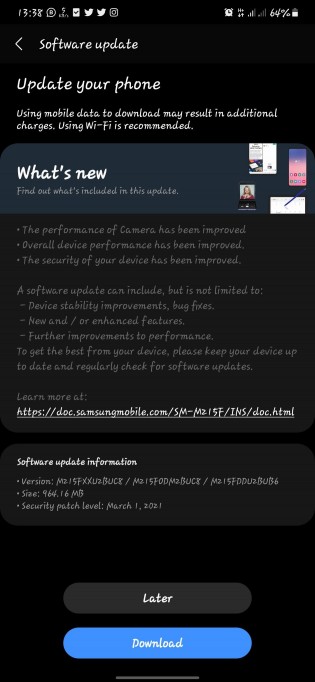
The Samsung Galaxy M21 announced last March with Android 10-based One UI 2.0 received One UI 2.1 in September and One UI 2.5 in November. The smartphone then picked up the Android 11-based One UI 3.0 update in January, and now it's receiving the One UI 3.1 Core update.

The new firmware includes the March 2021 Android patch and improves the Galaxy M21's security while also improving the camera and overall device performance. But aside from that, you can also expect it to bring new editing tools, Eye Comfort Shield, and improved stock apps to the smartphone.

Samsung Galaxy M21 One UI 3.1 Core update Samsung Galaxy M21 One UI 3.1 Core update
Samsung Galaxy M21 One UI 3.1 Core update

The One UI 3.1 Core update carries version number M215FDDU2BUB6 and requires a download of around 960MB. It's seeding in India at the time of writing this, but the rollout should expand to other countries soon.

If you live in India and haven't received the new update on your Galaxy M21 yet, you can head to the phone's Settings > Software update menu to check for it manually.

Source | Via

The Link Lonk


April 01, 2021 at 12:25PM
https://ift.tt/3wfJTTi

Samsung Galaxy M21 gets One UI 3.1 Core update - GSMArena.com news - GSMArena.com

https://ift.tt/2O3clnm
Samsung

Expert: Why Nike stands a 'reasonably good chance' to win its case vs Lil Nas X’s ‘Satan sneaker’ - Yahoo Finance

brande.indah.link

The New York Times

Americans Are on a Shopping Spree. These Workers Are Overwhelmed.

The stacks of cargo containers can tell a lot about how people spent their year at home during the pandemic. There were living-room sets from Bob’s Discount Furniture for families busy redecorating; kitchen appliances for new homebuyers; espresso machines for coffee lovers who became their own baristas; and cases of sparkling wines from France, Spain and Italy for those who drank more when they were pouring and could afford to indulge. The extraordinary surge of household cargo has shattered records at the Port of New York and New Jersey, a sprawling network of docks, terminals and open storage areas that span a half-dozen sites. It moved 755,437 standard cargo containers in October alone — the busiest month in the history of the port, which has handled cargo containers since the 1960s. Sign up for The Morning newsletter from the New York Times “Never before have we had anything like that,” said Bethann Rooney, the deputy director of port operations. “The cargo was coming fast and furious into the country.” The port, which is operated by the Port Authority of New York and New Jersey, a bistate municipal agency, is the largest on the East Coast and the third largest in the nation. Its cargo volumes were up to 23% higher each month from August through December 2020, compared with the same months in 2019. And the stuff just keeps coming. There was no post-holiday lull this winter as cargo volume in January rose 17% compared with the previous year. In February, it was up 7%, a new high for that month. When the pandemic set off buying sprees among U.S. consumers, it helped bring chaos to global shipping and created logistical challenges for freight moving between continents in colorful metal boxes that are stacked up like pieces in a Tetris game. A shortage of cargo containers resulted in widespread delays, and at some U.S. ports — including Los Angeles, where the virus slowed operations by sickening workers and truck drivers, or forcing them to quarantine — the influx of goods has created backlogs. But the shipping boom has turned out to be a bright spot for the Port Authority of New York and New Jersey. The port is the only part of the agency’s wide-ranging portfolio — which includes the region’s three major airports, the Port Authority Bus Terminal in Midtown Manhattan, the PATH train and six bridge-and-tunnel crossings — that has thrived during the pandemic. Though monthly cargo volumes initially dropped at the height of the pandemic as factories and stores shut down, they started picking up in August as shoppers opened their wallets and manufacturers and retailers scrambled to restock their shelves and get ahead of any future shutdowns. Still, the soaring cargo volumes have created more traffic and congestion at the port, and stretched equipment and supplies. The port is the gateway for freight headed across the Northeast as well as parts of the Midwest and Canada. And that was before a giant container ship, the Ever Given, got stuck in the Suez Canal for nearly a week and caused a traffic jam that will result in delays for some ships heading to the Port of New York and New Jersey and cause temporary upticks in cargo when the ships finally arrive. “We’re operating right now at the breaking point,” Rooney said. “This is going to be our normal at least for the first half of the year, and that’s as far as anyone is willing to predict at this point.” Even so, the increased port revenue has not been enough to offset the agency’s far larger financial losses from steep drops in passenger volumes at the airports and fewer cars and trucks at the bridges and tunnels. The Port Authority has projected that it will lose $3 billion in revenue from March 2020 to March 2022. The port has avoided the backlogs experienced at other ports, Rooney said, because officials took steps early in the pandemic to make sure the port did not run out of room. Many businesses bringing in imports during the pandemic had nowhere to put them because their warehouses were full and the port does not have its own warehouses. So the port dispatched scouts to find more than 70 off-site warehouses and parking lots in New Jersey and Connecticut that could be used for storage, and officials helped connect businesses with those sites. As a result, the port was able to keep its docks clear rather than clogged with cargo. Even before the pandemic, port officials had faced rising volumes as a result of regional population growth, Rooney said, and had developed an expansion plan, which includes building more rail infrastructure to move cargo. It also calls for extending the port’s operating hours to nights and weekends. (Some terminal operators have already added Saturday hours during the pandemic.) Across New York and New Jersey, the top category of shipping imports during the pandemic was beverages, spirits and vinegar. Total volume rose more than 9% in the second half of 2020 compared with the same period the year before, according to Mabel Ng, a product management director for IHS Markit, a company that tracks shipping through its Global Trade Atlas database. Shipments of wine, vermouth, hard cider and mead, and cordials and liqueurs all rose significantly as people became home bartenders. Nonalcoholic beverages such as flavored bottled waters and milk-based drinks were also in higher demand. Imports of furniture, bedding, cushions and lamps soared nearly 35% in the second half of 2020, compared with the same period a year earlier, reflecting a boom in home decorating. The increases included wooden furniture used in kitchens and bedrooms, metal-frame seats, mattresses and supports, and desk, table and floor lamps. As people spent much more time cooking, baking and eating at home, the roughly 117,000 tons of plastic table and kitchen wares shipped to the port in the second half of last year represented a 12.5% jump from the same period the year before. For Jeannie Kim, 31, a marketing director in Brooklyn, it was a good time to upgrade to a Nespresso coffee machine, which uses capsules. “Before it wasn’t really a priority because I would mix it up with coffee shops,” she said. “In quarantine, I’m working at home so I felt justified to invest in a better machine because it’s my sole source of coffee now.” People have splurged on other drinks, too. Many have switched to premium imported brands, said Peter Lijewski, a vice president for Breakthru Beverage Group, a wholesale beverage distributor, which has received more shipments of premium wines and spirits, including French, Italian and Spanish wines and French Champagne and cognac. “There’s this whole experiment and experience in terms of brands people had never tried before,” Lijewski said. “It’s like trying a new sport or a new restaurant. I may never have bought a $25 bottle of wine before and I tried it and, Wow, it’s really good.” For others, the pandemic has been a chance to re-imagine their homes. Bob’s Discount Furniture, a national chain of 140 stores, has never been busier with the biggest demand for living-room sets, including sofas and sectionals, followed by bedroom sets. “With the increased time at home, people are craving comfort,” said Carol Glaser, the company’s chief merchandising officer. “Furniture is the comfort food of the home.” Kitchen and laundry-room makeovers, as well as a surge in home sales as more city dwellers moved to the suburbs, have also helped fuel a “double-digit increase” in LG’s sales of refrigerators, stoves, dishwashers, washing machines and dryers shipped from factories in Asia, according to John I. Taylor, a senior vice president at LG Electronics USA. “We’ve never seen this level of demand in the industry and our factories are working overtime,” Taylor said. The company is also importing more televisions, computer monitors and laptops, he added, as people spend more time working, studying or just relaxing at home. Hattie Kolp, 29, has been one of the fixer-uppers helping to drive the surge in cargo shipping. Her home improvement projects in a rent-stabilized Upper West Side apartment have helped attract more than 32,000 followers on Instagram. When Kolp, a special-education teacher at a Harlem school, started working more at home, she turned her guest bedroom into an office complete with a green velvet couch and bookshelves made in Asia that she ordered online. At one point, she tracked her couch crossing the Pacific in a cargo container to a West Coast port before it traveled over land to Manhattan. “I think it just shows us that very little is made in the U.S.,” she said. “It’s really bringing attention to how far stuff travels to get to us.” This article originally appeared in The New York Times. © 2021 The New York Times Company

The Link Lonk


April 01, 2021 at 12:21AM
https://ift.tt/3fvCOrO

Expert: Why Nike stands a 'reasonably good chance' to win its case vs Lil Nas X’s ‘Satan sneaker’ - Yahoo Finance

https://ift.tt/3g93dIW
Nike

Featured Post

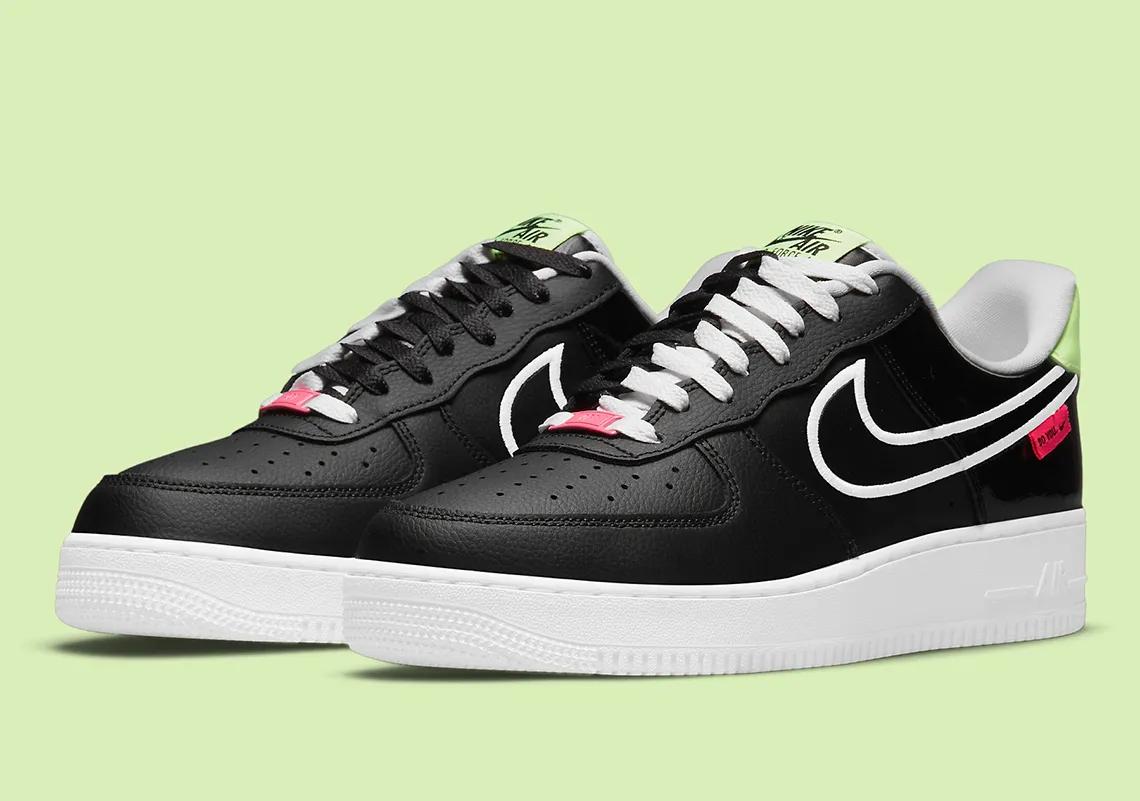
The Nike Air Force 1 Echoes The “Do You” Mantra - Sneaker News

brande.indah.link Similar to “Just Do It,” Nike’s latest slogan — “Do You” — encourages a greater, growing audience. But unlike the aforeme...

Popular Posts